Photographer Simon Norfolk is speaking at Derby’s Quad gallery on 19 November 2009 at 6.30 pm. book now to avoid disappointment £3
Tuesday, 13 October 2009

Thursday, 21 May 2009
Spanish Tourists Arrested outside Buckingham Palace
According to Typically Spanish two Spaniards visiting London were swooped on by 10 police officers and surrounded as well as being arrested on terrorism charges because one of them had photographed the wall surrounding Buckingham Palace
Tuesday, 26 February 2008
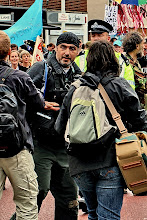
Photographers Under Attack!
THOUSANDS OF PEOPLE TAKE PHOTOS EVERY DAY.
WHAT IF ONE OF THEM SEEMS ODD?
Terrorists use surveillance to help plan attacks, taking photos and making notes about security measures like the location of CCTV cameras. If you see someone doing that, we need to know. Let experienced officers decide what action to take.
Well that was the strap line on the back cover of the London paper today and I predict a lot of stories coming out of it about photographers just trying to enjoy their hobbies, but now being constantly stopped by police, especially in a tourist hotspot like London.
Type in CCTV on Flickr (15,439 results) and see how many images you get or try the same on an image search Google (3,130,000 results) hmmm...
I doubt very much terrorists are going to be using Nikon D3 or Canon MkIII ds to do this kind of target research but more likely to use an average Joe tourist type of camera, the problem is the non-photographing public have no way of knowing one from the other and G9 users, best take care as it is such a discrete styled camera, even their add shows a compact camera as well as mobile phones, however with the mobile phone its how many they have that makes them suspicious, not the phone itself.

My personal feelings on this is that it makes me feel like a second rate citizen, like I have been accused of doing something wrong when I haven't and my human rights have been infringed, heck I have even photographed CCTV cameras in the past, for aesthetics and as a statement about the times we live in and issues we face.
Check out the resources for the photographer in the sidebar and download and print the UK Photographers Rights PDF
Tuesday, 19 February 2008
Whistle-blower site taken offline :: BBC
A dedicated website called Wikileakes.org has been forced offline with the courts putting the interests of big corporations as a priority over law, journalism and public interest. Even more worrying is how admin's details, contacts, payment details, IP addresses and any associated data to be handed over under the terms of the court order, which is very worrying as there is no risk assessment as to what that data contains and could be endangering journalists and individuals alike. Wikileaks.org were given just one hours notice of the court hearing which was by email, while the Swiss bank group who brought the court action, remain anonymous
In a classic case of Censorship which is increasing as Reporters Without Borders has documented in its 2008 report which is a scathing attack on Public Officials around the world, combined with HotBlack's report on how the UK government was gearing up to stop mobile phones from working with new media, to limit/stop media sharing and social networking websites at their will.
Whistle-blower site taken offline
The case was brought by lawyers working for a Swiss bank
A controversial website that allows whistle-blowers to anonymously post government and corporate documents has been taken offline in the US.
Wikileaks.org, as it is known, was cut off from the internet following a California court ruling, the site says.
The case was brought by a Swiss bank after "several hundred" documents were posted about its offshore activities.
Other versions of the pages, hosted in countries such as Belgium and India, can still be accessed.
However, the main site was taken offline after the court ordered that Dynadot, which controls the site's domain name, should remove all traces of wikileaks from its servers.
The court also ordered that Dynadot should "prevent the domain name from resolving to the wikileaks.org website or any other website or server other than a blank park page, until further order of this Court."
Other orders included that the domain name be locked "to prevent transfer of the domain name to a different domain registrar" to prevent changes being made to the site.
Wikileaks claimed that the order was "unconstitutional" and said that the site had been "forcibly censored".
Web names
The case was brought by lawyers working for the Swiss banking group Julius Baer. It concerned several documents posted on the site which allegedly reveal that the bank was involved with money laundering and tax evasion.
The site was founded in 2006
The documents were allegedly posted by Rudolf Elmer, former vice president of the bank's Cayman Island's operation.
A spokesperson for Julius Baer said he could not comment on the case because of "pending legal proceedings".
The BBC understands that Julius Baer asked for the documents to be removed because they could have an impact on a separate legal case ongoing in Switzerland.
The court hearing took place last week and Dynadot blocked access from Friday evening.
Wikileaks says it was not represented at the hearing because it was "given only hours notice" via e-mail.
A document signed by Judge Jeffery White, who presided over the case, ordered Dynadot to follow six court orders.
As well as removing all records of the site form its servers, the hosting and domain name firm was ordered to produce "all prior or previous administrative and account records and data for the wikileaks.org domain name and account".
The order also demanded that details of the site's registrant, contacts, payment records and "IP addresses and associated data used by any person...who accessed the account for the domain name" to be handed over.
Wikileaks allows users to post documents anonymously.
Information bank
The site was founded in 2006 by dissidents, journalists, mathematicians and technologists from the US, Taiwan, Europe, Australia and South Africa.
It so far claims to have published more than 1.2 million documents.
It provoked controversy when it first appeared on the net with many commentators questioning the motives of the people behind the site.
It recently made available a confidential briefing document relating to the collapse of the UK's Northern Rock bank.
Lawyers working on behalf of the bank attempted to have the documents removed from the site. They can still be accessed.
Dynadot was contacted for this article but have so far not responded to requests for comment.


Tuesday, 12 February 2008
Polaroid film faces the final shutter
Polaroid film faces the final shutter
By Justin Baer in New York
Published: February 8 2008 23:48 | Last updated: February 8 2008 23:48
Polaroid, the US company that introduced instant photography 60 years ago, is to stop making film.
The group, which stopped making instant cameras a year ago, will now complete its transition to digital printers, televisions and DVD players by shutting four analogue film factories.
Polaroid cameras and the white-bordered prints they produced were common at family reunions and crime scenes alike for decades, reaching peak popularity during the 1960s and 1970s. They would also become a medium of choice for artists such as Ansel Adams, David Hockney and Robert Rauschenberg.
The advent of digital technology has pushed Eastman Kodak and other veteran manufacturers to abandon film production in recent years. Soon after Polaroid was sold to private investment firm Petters Group in 2005, the management started its own gradual retreat from analogue photography.
Polaroid will close two factories in Massachusetts as well as facilities in Mexico and the Netherlands, eliminating about 450 jobs. The company plans to make enough film to last customers until next year, Thomas Beaudoin, chief operating officer, said.
He said Polaroid’s consumer-electronics business generated almost $1bn in revenue. The company had high hopes for its battery-powered digital printers, and was in talks with mobile-phone carriers and other potential business partners.
He saw this transition as the start of a third era for Polaroid, which existed for its first few decades primarily as a maker of sunglasses and protective goggles for the US military.
Polaroid sold its eyecare division last year.
The company expects its mobile printers to attract even some of the most devout fans of instant photography. But for those unmoved by the technology, there is a chance another manufacturer will produce the film elsewhere.
Mr Beaudoin said: “We’re working very hard to find some alternatives with people who might be able to take the recipe.
“We can’t promise anything.”
Copyright The Financial Times Limited 2008
FT.com / Companies / Consumer industries - Polaroid film faces the final shutter
Monday, 11 February 2008
Out of Africa - Reuters Photographers
Some of these images are very graphic and caution is advised
Out of Africa
February 9th, 2008, filed by David Viggers
I’ve been trying to write about some sport images that caught my eye while trawling through the Reuters file but I keep getting hung up on our pictures from Kenya.
They are so raw, so powerful and uncompromising that even the most accomplished images of cossetted sportsmen performing in completely controlled circumstances seem insignificant in comparison.

Wednesday, 6 February 2008
Write your own Guardian News
Brand Republic is reporting that Guardian Unlimited, the most visited UK newspaper online, is set to jump on the social networking bandwagon after striking a deal with Pluck, a provider of social networking platforms. The deal will see Guardian News and Media, which publishes The Guardian and The Observer, roll out tools on its Web properties, enabling users to interact with one another and add content to existing articles.
http://short.zen.co.uk/?id=946
Tuesday, 22 January 2008
Police seize photographers film
An amateur photographer has told how police seized his film as he was out taking snaps in a Hull shopping centre.
Steve Carroll, of Kent, was visiting relatives in Hull in December when he decided to do some "street photography" in the city's Prospect Centre.
Shoppers reported him to the police, who took his film because he seemed to be operating in "a covert manner".
Mr Carroll lodged a complaint against Humberside Police but an investigation concluded its officers acted correctly.
Officers have common law powers of seizure, a force spokeswoman said.
More on BBC
Banned from owning a camera
A paedophile who took pictures of a boy being abused and distributed them round the world has been banned from owning anything capable of taking photographs.
More information on the BBC
Thursday, 3 January 2008
Kremlin eyes internet control ...
The Russian government is looking to create a Cyrillic internet, but is it just another case of Big Brother controlling its citizens?
- Gavin Knight
- The Guardian,
- Thursday January 3 2008

The growing cold war with Russia has a new front besides oil fields and undersea territorial claims: the internet. Russia's government is pushing for greater control over the Russian-language part of the net - and its aim seems to be to create a web that operates in Cyrillic, completely independent from the wider web.
The problem for Russia is that its top-level domain - with the ASCII suffix .ru - translates into Cyrillic as .py, the domain name of Paraguay. That could pose security problems for Russian users. Kim Davies, who controls the domain names at the international domain naming agency Icann told the Guardian: "Russia has a second top level domain name of .ru in Ascii code, but is pushing for .rf in Cyrillic."
Wolfgang Kleinwachter, special adviser to the chairman of the Internet Governance Forum, says: "The proposal for 'Russian internet' would look at how they can communicate better inside the country. The internationalised domain name gives them an opportunity to do things which are now being tested in China, where they are currently using Chinese characters for three top-level domains: .net, .com and .cn."
A tale of two servers
The key is whether Russian international domain names would use their own root servers - which decide where to route your internet requests - independent of the existing internet root servers which are mainly based in the US.
Kleinwachter thinks that the worst-case scenario would mean everyone would have to register a domain name using the .rf top level domain in Cyrillic. "Then [Russia] would have their own root and it's much easier to control the top-level domain than hundreds of thousands of secondary level domains."
That would, arguably, mean Russians are safe from Paraguayan phishing - but it would also give the Russian government more control of the net and leave Russian citizens isolated from the international community. Davies explains that Russian Cyrillic keyboards make it difficult for Russian users to search for domain names using the roman letters of Ascii code. Without a bridge to coordinate it with Ascii code, a Russian-language internet would be cut off from the global net.
China's citizens could similarly become isolated from international opinion. "The Chinese have the option now to keep the domain .cn in Ascii code or to cut it." Kleinwachter says. "If they cut it then they have an opportunity to build something like a bridge which would link the Chinese internet to the Ascii internet. The Russians, like the Chinese, discussed this option. My impression is that the Russian Foreign Ministry is much more open to such an option than [China's] Ministry of Economic Development and Trade. Another way would be to give every citizen a fixed IP address, which would go with you wherever you approach the internet."
Setting up a new root server would not be expensive, Davies says, but would cause "technical issues". Guillaume Lovet, head of the threat response team at security company Fortinet, explains: "If it's about re-implementing internet protocols, it would be like installing new, additional firmware on our home router, and new drivers on each network-enabled computer at home. If it's about rebuilding everything from scratch, it is comparable to throwing everything in the bin."
International isolation
Davies says the key downside would be how much the Russians stand to lose out on the global operability of the web unless bridges are built with the Ascii-dominated global internet. "Russians estimate that 90% of the communication will be within Russia and just 10% will go outside," says Kleinwachter. But it's that 10% which would feel the real difference.
Kleinwachter says the speculation is that people will need a password authorised by government agencies to use the global internet. The Kremlin therefore would be able to control what communication the individual is having with the rest of the world. The government says that would help it monitor cybercrime.
Lovet is more sceptical. "Russia has a very strong academic tradition of technical universities, which form very sharp and competent computer scientists. At the same time, the average income per head is extremely low. This combination creates an explosive cocktail. Any attempt to confine Russian hackers inside some kind of Russian cyberspace is bound to fail."
Other security experts go even further. "This will put a wall between cybercriminals and their victims," says Jose Nazario, from Arbor, who works to protect governments and corporations from cyber attacks emanating from Russia. "It makes it very difficult to track Russian cybercrime. Security experts are just starting to get a picture of their methods, and this will slow us down dramatically. It is also an escalation of tension between Putin's Russia and the west."
http://www.guardian.co.uk/technology/2008/jan/03/internet.censorship
Technorati Tags: Internet censorship Russia
Tuesday, 18 December 2007
Life Spy
The Spectre of Hope
The 'Spectre of Hope' is a documentary based on the latest work of photographer Sebastião Salgado.
Salgado spent 6 years travelling to over 40 countries, taking pictures of globalisation and its consequences - most notably, the mass migrations of populations around the world. In the film, Salgado presents his remarkable photographs in conversation with John Berger.
Go and watch LENGTH 52 min :)
Sunday, 2 December 2007
Love in central Stockholm

"Homeless also have a sex-life" was their message. They put a bed in Sergels square in central of Stockholm and made out.
Just goes to show the power of the flickr comunity, do you think an editor could ever get such a picture via a professional photographer?
Tuesday, 20 November 2007
100 Journalists aressted in Pakistan
Journalists arrested in Pakistan
 A journalist recovers after the confrontation with police |
Most were held in Karachi and several detained in Hyderabad.
Police baton-charged the Karachi journalists after they tried to stage a protest march. Some of them were hurt.
When President Pervez Musharraf imposed emergency rule on 3 November, radio and TV news was banned, as was criticism of the government.
Country-wide
Heavy contingents of police were deployed on roads to the Karachi Press Club to stop the rally there.
 Police stopped the marchers going to a TV station
It was part of a country-wide protest organised by the Pakistan Federal Union of Journalists (PFUJ) against the media curbs.
The journalists were planning to hold a demonstration outside the Karachi offices of the ARY TV channel, one of half a dozen news channels that cable operators stopped airing after the emergency was imposed.
The BBC's M Ilyas Khan in Karachi says police beat up a number of journalists in front of the press club entrance.
The arrests came shortly after the government said it released some 3,400 people jailed under emergency rule.
The release of political opponents has been a key demand of opposition parties who are threatening to boycott parliamentary elections in January.
A number of leading political figures are still being held.Monday, 19 November 2007
US Plans Case Against AP Photographer
The U.S. military plans to seek a criminal
case in an Iraqi court against an award-winning Associated Press
photographer but is refusing to disclose what evidence or accusations
would be presented.
The journalist, Bilal Hussein, has already been imprisoned without charges for more than 19 months and there have been many calls and petitions on Lightstalkers for his release and calls for his freedom have been backed by groups such as the Committee to Protect Journalists.
An AP attorney on Monday strongly protested the decision, calling the U.S. military plans a "sham of due process."
case in an Iraqi court against an award-winning Associated Press
photographer but is refusing to disclose what evidence or accusations
would be presented.
The journalist, Bilal Hussein, has already been imprisoned without charges for more than 19 months and there have been many calls and petitions on Lightstalkers for his release and calls for his freedom have been backed by groups such as the Committee to Protect Journalists.
An AP attorney on Monday strongly protested the decision, calling the U.S. military plans a "sham of due process."
The military has not yet defined the
specific charges against Hussein. Previously, the military has pointed
to a range of suspicions that attempt to link him to insurgent
activity.
The AP rejects all the allegations and contends it
has been blocked by the military from mounting a wide-ranging defense
for Hussein and claims that Hussein was interrogated at Camp Cropper this year without legal counsel.
Hussein was part of the AP's Pulitzer Prize-winning photo team
in 2005
More information on AP Website
Powered by ScribeFire.
Tuesday, 13 November 2007
Yahoo settles its China lawsuit
Source ::BBC
 Yahoo senior officers were criticised in a congressional hearing |
No details have been given of the settlement but Yahoo will be covering legal costs.
The case alleged that Yahoo had provided information to the Chinese government that had then been used to prosecute the dissidents.
Yahoo said it had to comply with Chinese laws to operate in the country.
A statement released by the World Organization for Human Rights USA, which brought the case, said Yahoo had decided to settle the case following criticism at a US Congressional hearing on 6 November.
'Inexcusably negligent'
A Congressional panel criticised Yahoo for not giving full details to its probe into the jailing of a reporter by Chinese authorities.
Yahoo had been "at best inexcusably negligent" and at worst "deceptive" in evidence given to the House Foreign Affairs Committee last year, the panel said.
One journalist cited in the case, Shi Tao, was tracked down and jailed for 10 years for subversion after Yahoo passed on his e-mail and IP address to officials.
He was convicted in 2004 of divulging state secrets after posting online a Chinese government order forbidding media organisations from marking the anniversary of the Tiananmen Square massacre.
Yahoo's original response to the lawsuit acknowledged releasing information to the Chinese government.
But it argued that there was little connection between the information the firm gave and the ensuing arrests and imprisonment of its users.
Michael Callahan, Yahoo's executive vice-president and general counsel, then told a congressional panel in February 2006 that he did not know why the Chinese authorities wanted to trace Shi Tao.
Last week, Mr Callahan wrote to the committee admitting that other Yahoo employees had a document saying it was to do with the "suspected illegal provision of state secrets".
Mr Callahan said the information only came to his attention months after he testified.
Powered by ScribeFire.
Wednesday, 7 November 2007
Dutch government admits spying on journalists
5 November 2007
The Dutch government today admitted officials hacked into a media agency's
computers to find out what stories were being written about them.
The GPD news agency only discovered what was going on when one ministry press
officer rang up to complain about a story that had not even been published.
Marcel van Lingen, editor-in-chief of the agency which serves more than a
dozen newspapers in the Netherlands and Belgium, accused the government of
"spying."
The Social Affairs Ministry "used stolen information to influence (our)
reporting," he said.
The ministry confirmed in a statement some of its employees had accessed
GPD's internal site and apologised.
"It is not our policy and we reject it. The department will investigate the
matter and take steps to prevent it happening again in the future," said a
spokesman.
It invited public prosecutors to investigate whether any criminal acts were
committed. Other news outlets criticised the ministry's action, and The
Netherlands' Union of Journalists' chief Thomas Bruning called it a "kick in the
shins for the independent role that journalism plays."
source :: Press Gazette
Powered by ScribeFire.
Monday, 5 November 2007
Plodshop Creative Suit 3
First strike software have just launched the latest version of Plodshop Creative suite CS3
Developed
by Warren Terror Software Plodshop is intended as an image verification
and anti manipulation software for digital images and is to address
major security issues in the industry standard Adobe Photoshop, Picnik,
Tesco Photo ReStyle and Piccasa2
You can see the full product review by EPUK (who are press and editorial Photographers discussion group) here:
http://www.epuk.org/Blogs/739/new-epuk-software-release
Well
at least they see it for what it is
Powered by ScribeFire.
Friday, 2 November 2007
Richard Branson

Richard Branson was in Derby, UK today to open the new Arts, Design and Technology building, built at a cost of £21 million pounds by the University of Derby for its new education centre
Monday, 29 October 2007
The Duty of the Photographer
Out From Behind a Camera at a Khmer Torture House
When I read this I have very mixed emotions, looking at images of people who were tortured just after they had their photo taken. Most look as if they are posing for the family album, but they dont smile, others look afraid...and others have been tortured! (Lifespy)
NYTimes story here
the photos are here

PHNOM PENH, Cambodia, Oct. 25 — He had a job to do, and he did it supremely well, under threat of death, within earshot of screams of torture: methodically photographing Khmer Rouge prisoners and producing a haunting collection of mug shots that has become the visual symbol of Cambodia’s mass killings
 Back Story With Seth Mydans and Graham Bowley (mp3)

Tuol Sleng Museum of Genocide
Before killing the prisoners, the Khmer Rouge photographed, tortured and extracted written confessions from their victims.
“I’m just a photographer; I don’t know anything,” he said he told the newly arrived prisoners as he removed their blindfolds and adjusted the angles of their heads. But he knew, as they did not, that every one of them would be killed.
“I had my job, and I had to take care of my job,” he said in a recent interview. “Each of us had our own responsibilities. I wasn’t allowed to speak with prisoners.”
That was three decades ago, when the photographer, Nhem En, now 47, was on the staff of Tuol Sleng prison, the most notorious torture house of the Khmer Rouge regime, which caused the deaths of 1.7 million people from 1975 to 1979.
This week he was called to be a witness at a coming trial of Khmer Rouge leaders, including his commandant at the prison, Kaing Geuk Eav, known as Duch, who has been arrested and charged with crimes against humanity.
The trial is still months away, but prosecutors are interviewing witnesses, reviewing tens of thousands of pages of documents and making arrests.
As a lower-ranking cadre at the time, Mr. Nhem En is not in jeopardy of arrest. But he is in a position to offer some of the most personal testimony at the trial about the man he worked under for three years.
In the interview, Mr. Nhem En spoke with pride of living up to the exacting standards of a boss who was a master of negative reinforcement.
“It was really hard, my job,” he said. “I had to clean, develop and dry the pictures on my own and take them to Duch by my own hand. I couldn’t make a mistake. If one of the pictures was lost I would be killed.”
But he said: “Duch liked me because I’m clean and I’m organized. He gave me a Rolex watch.”
Fleeing with other Khmer Rouge cadres when the government was ousted by a Vietnamese invasion in 1979, Mr. Nhem En said he traded that watch for 20 tins of milled rice.
Since then he has adapted and prospered and is now a deputy mayor of the former Khmer Rouge stronghold Anlong Veng. He has switched from an opposition party to the party of Prime Minister Hun Sen, and today he wears a wristwatch that bears twin portraits of the prime minister and his wife, Bun Rany.
Last month an international tribunal arrested and charged a second Khmer Rouge figure, who is now being held with Duch in a detention center. He is Nuon Chea, 82, the movement’s chief ideologue and a right-hand man to the Khmer Rouge leader, Pol Pot, who died in 1998.
Three more leaders were expected to be arrested in the coming weeks: the urbane former Khmer Rouge head of state, Khieu Samphan, along with the former foreign minister, Ieng Sary, and his wife and fellow central committee member, Ieng Thirith.
All will benefit from the caprice of Mr. Nuon Chea, who complained that the squat toilet in his cell was hurting his ailing knees and was given a sit-down toilet.
Similar toilets are being installed in the other cells, said a tribunal spokesman, Reach Sambath, “So they will all enjoy high-standard toilets when they come.”
It is not clear whether any of the cases will be combined. But even if the defendants do not see one another, their testimony, harmonious or discordant, will put on display the relationships of some of the people who once ran the country’s killing machine.
In a 1999 interview, Duch implicated his fellow prisoner, Mr. Nuon Chea, in the killings, citing among other things a directive that said, “Kill them all.”
Mr. Nhem En’s career in the Khmer Rouge began in 1970 at age 9 when he was recruited as a village boy to be a drummer in a touring revolutionary band. When he was 16, he said, he was sent to China for a seven-month course in photography.
He became the chief of six photographers at Tuol Sleng, where at least 14,000 people were tortured to death or sent to killing fields. Only a half dozen inmates were known to have survived.
He was a craftsman, and some of his portraits, carefully posed and lighted, have found their way into art galleries in the United States.
Hundreds of them hang in rows on the walls of Tuol Sleng, which is now a museum, their fixed stares tempting a visitor to search for meaning here on the cusp of death. In fact, they are staring at Mr. Nhem En.
The job was a daily grind, he said: up at 6:30 a.m., a quick communal meal of bread or rice and something sweet, and at his post by 7 a.m. to wait for prisoners to arrive. His telephone would ring to announce them: sometimes one, sometimes a group, sometimes truckloads of them, he said.
“They came in blindfolded, and I had to untie the cloth,” he said.
“I was alone in the room, so I am the one they saw. They would say, ‘Why was I brought here? What am I accused of? What did I do wrong?’”
But Mr. Nhem En ignored them.
“‘Look straight ahead. Don’t lean your head to the left or the right.’ That’s all I said,” he recalled. “I had to say that so the picture would turn out well. Then they were taken to the interrogation center. The duty of the photographer was just to take the picture.”
View the Khmer Rouge photographs (TuolSleng.com)
Thursday, 25 October 2007
Whistleblower? Journalist? Citizen journalist? or just Censored?
Whistleblower? Journalist? Citizen journalist? Wikileaks writer,
volunteer, supporter or techie? Get advice and talk with other people
like you on the Wikileaks secure chat (also good for safe interviews
with anonymous sources).
Goto https://secure.wikileaks.org/wiki/Wikileaks:Chat
Click "chat" to the right. Click into the box at the bottom of the
chat page and and start typing. For greater reliability and ease of
use, you can install a chat program as described below. Our chat
system is designed to work on almost any browser in any country. It
has minimal bandwidth requirements and will even work over dialups or
mobile phones.
We will create sub-channels (e.g for the Kenyan election) if there is
sufficient demand (let us know!).

Subscribe to:
Posts (Atom)

 Posts
Posts

